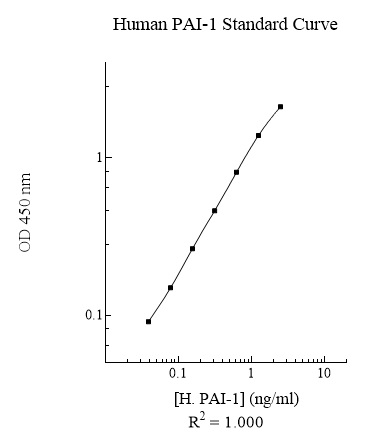
Publications citing Assaypro: Human PAI-1 ELISA Kit ... (122 results)
Please use discretion when following external links; Assaypro cannot guarantee the validity and security of all citation links provided.Evaluation of thrombomodulin/thrombin activatable fibrinolysis inhibitor function in plasma using tissue-type plasminogen activator-induced plasma clot lysis
Evaluation of thrombomodulin/thrombin activatable fibrinolysis inhibitor function in plasma using tissue-type plasminogen activator-induced plasma clot lysis time
Exposure to incense burning, biomarkers, and the physical health of temple workers in Taiwan.
Evaluating the effect of antidiabetic treatment on haemostatic and fibrinolytic parameters among type 2 diabetics in Ilorin, Nigeria
Plasminogen Activator Inhibitor 1 (PAI-1) and Haematologic Parameters in HIV- Positive Patients on Protease Inhibitor-Based HAART Regimen: A Case-Control Study
Regular resistance training enhances fibrinolytic potential but does not affect coagulation
Cadmium induces plasminogen activator inhibitor-1 via Smad2/3 signaling pathway in human endothelial EA. hy926 cells
Cadmium induces plasminogen activator inhibitor-1 via Smad2/3 signaling pathway in human endothelial EA.hy926 cells.
Genotype Variations and Association between PAI-1 Promoter Region (4G/5G and -844G/A) and Susceptibility to Acute Myocardial Infarction and Chronic Stable Angina
Regular Resistance Training Enhances Fibrinolytic Potential but Does Not Affect Coagulation
Drospirenone Effects on the Plasminogen Activator System in Immortalized Human Endometrial Endothelial Cells
Arsenite Inhibits Tissue-Type Plasminogen Activator Synthesis through NRF2 Activation in Cultured Human Vascular Endothelial EA.hy926 Cells
Nobiletin represses change in the levels of blood coagulation markers in the LPS-induced rat DIC model
Endothelial dysfunction in children with frequently relapsing and steroid-resistant nephrotic syndrome
Alu-repeat polymorphism in the tissue plasminogen activator (t-PA) gene, seminal t-PA concentration, and male fertility impairment: A case-control study
Epigenetic Modulation by Apabetalone Counters Cytokine-Driven Acute Phase Response In Vitro, in Mice and in Patients with Cardiovascular Disease
Hemostatic Adaptations to High Intensity Interval Training in Healthy Adult Men
Acute fbrinolysis shutdown occurs early in septic shock and is associated with increased morbidity and mortality: results of an observational pilot study
Relationship among HbA1c and Some Markers of Endothelial Damage in Type 2 Diabetes Mellitus
Coagulation failure is associated with bleeding events and clinical outcome during systemic inflammatory response and sepsis in acute‐on‐chronic liver failure: An observational cohort study
Acute fibrinolysis shutdown occurs early in septic shock and is associated with increased morbidity and mortality: results of an observational pilot study
The effects of different therapeutic modalities on cardiovascular risk factors in women with polycystic ovary syndrome: A random?zed controlled study
Homocysteine-Enhanced Proteolytic and Fibrinolytic Processes in Thin Intraluminal Thrombus and Adjacent Wall of Abdominal Aortic Aneurysm: Study In Vitro
Tissue factor levels and the fibrinolytic system in thin and thick intraluminal thrombus and underlying walls of abdominal aortic aneurysms
Establishment of disseminated intravascular coagulation (DIC) modelby a single iv administration of Escherichia coli-derived lipopolysaccharide (LPS) to cynomolgus monkeys and evaluation of itspathophysiological status
Can biomarkers of coagulation, platelet activation, and inflammation predict mortality in patients with hematological malignancies?
Evaluation of cardiac risk marker levels in obese and non-obese patients with polycystic ovaries.
Dysfunctional fibrinolysis and cerebral venous thrombosis
Establishment of disseminated intravascular coagulation (DIC) model by a single iv administration of Escherichia coli-derived lipopolysaccharide (LPS) to cynomolgus monkeys and evaluation of its pathophysiological status.
Plasma Levels of Plasminogen Activator Inhibitor Type 1 and Vitronectin in Children With Cancer
Intervention of chlorogenic acid, caffeic acid and ferulic acid on the expression of inflammation-related molecules in endothelial cells caused by complement bypass activation
Utility of a single mid-trimester measurement of plasminogen activator Type 1 and fibronectin to predict preeclampsia in pregnancy
Frailty has a stronger association with inflammation than age in older veterans
Plasma Levels of Plasminogen Activator Inhibitor Type 1 and Vitronectin in Children With Cancer.
Oral citrulline supplementation protects female mice from the development of non-alcoholic fatty liver disease (NAFLD)
Comparison of the effects of intensive insulin treatment modalities on cardiovascular biomarkers in type 1 diabetes mellitus.
A microfluidic cell culture system for monitoring of sequential changes in endothelial cells after heat stress.
Tranexamic Acid Compared with Placebo for Reducing Total Blood Loss in Hip Replacement Surgery
Coagulation, Fibrinolysis and Inhibitors in Failing Filters during Continuous Venovenous Hemofiltration in Critically Ill Patients with Acute Kidney Injury: Effect of Anticoagulation Modalities.
Utility of a single mid-trimester measurement of plasminogen activator Type 1 and fibronectin to predict preeclampsia in pregnancy
Coagulation, fibrinolysis and inhibitors in failing filters during continuous venovenous hemofiltration in critically Ill patients with acute kidney injury: effect of
Comparison of the effects of intensive insulin treatment modalities on cardiovascular biomarkers in type 1 diabetes mellitus
Coagulation, fibrinolysis and inhibitors in failing filters during continuous venovenous haemofiltration in critically ill patients with acute kidney injury: effect of anticoagulation modalities
Effects of Selenium Supplementation on Soluble FMS-Like Tyrosine Kinase-1 and Glutathione Peroxidase Levels and the Plasminogen Activator Inhibitor-1: Plasminogen Activator Inhibitor-2 Ratio in Pregnant Women
Effect of heart rate control on coagulation status in patients of rheumatic mitral stenosis with atrial fibrillation – A pilot study ☆
Association between biomarkers of endothelial injury and hypocoagulability in patients with severe sepsis: a prospective study
Pleural Effusion and Plasma Levels of Fibrinolytic Parameters in Tuberculosis Pleurisy and Contribution to the Diagnosis.
Comparison of effects of gliclazide, metformin and pioglitazone monotherapies on glycemic control and cardiovascular risk factors in patients with newly diagnosed
Increased thrombotic and impaired fibrinolytic response to acute exercise in patients with essential hypertension: The effect of treatment with an angiotensin II receptor blocker
Comparison of Eff ects of Gliclazide, Metformin and Pioglitazone Monotherapies on Glycemic Control and Cardiovascular Risk Factors in Patients with Newly Diagnosed Uncontrolled Type 2 Diabetes Mellitus
Pleural effusion and plasma levels of fibrinolytic parameters in tuberculosis pleurisy and contribution to the diagnosis
Comparison of effects of gliclazide, metformin and pioglitazone monotherapies on glycemic control and cardiovascular risk factors in patients with newly diagnosed uncontrolled type 2 diabetes mellitus.
Association of left ventricular longitudinal strain with mortality among stable hemodialysis patients with preserved left ventricular ejection fraction.
Effects of Hormone Replacement Therapy on Plasma and Tissue Fibrinolytic Activity in a Rat Model of Surgically Induced Menopause
Increased thrombotic and impaired fibrinolytic response to acute exercise in patients with essential hypertension: The effect of treatment with an angiotensin II receptor blocker
Association of the Plasminogen Activator Inhibitor-1 (PAI-1) Gene -675 4G/5G and -844 A/G Promoter Polymorphism with Risk of Keloid in a Chinese Han Population
Sputum plasminogen activator inhibitor-1 elevation by oxidative stress-dependent nuclear factor-?B activation in COPD
Coagulation factors, fibrinogen and plasminogen activator inhibitor-1, are differentially regulated by yellow fever virus infection of hepatocytes
Sputum Plasminogen Activator Inhibitor-1 Elevation by Oxidative Stress-Dependent Nuclear Factor-kappaB Activation in COPDPlasminogen Activator Inhibitor-1 Elevation in COPD
Haemostatic factors and intraluminal thrombus thickness in abdominal aortic aneurysm. Is secondary fibrinolysis relevant?
Effect of a Congolese herbal medicine used in sickle cell anemia on the expression of plasminogen activators in human coronary aortic endothelial cells culture
Association of Left Ventricular Longitudinal Strain with Mortality among Stable Hemodialysis Patients with Preserved Left Ventricular Ejection Fraction
Blood levels of histone-complexed DNA fragments are associated with coagulopathy, inflammation and endothelial damage early after trauma
Trauma-Induced Coagulopathy: Standard Coagulation Tests, Biomarkers of Coagulopathy, and Endothelial Damage in Patients with Traumatic Brain Injury
Circadian rhythms in the efficacy of intravenous alteplase in patients with acute ischemic stroke and middle cerebral artery occlusion.
Trauma-Induced Coagulopathy: Standard Coagulation Tests, Biomarkers of Coagulopathy, and Endothelial Damage in Patients with Traumatic Brain Injury
Blood levels of histone-complexed DNA fragments are associated with coagulopathy, inflammation and endothelial damage early after trauma
High sCD40L levels early after trauma are associated with enhanced shock, sympathoadrenal activation, tissue and endothelial damage, coagulopathy and mortality
PLASMATIC SIL 6R/IL-6 RATIO AS A POTENTIAL PREDICTOR OF HIGH GLEASON SUM AT RADICAL PROSTATECTOMY
Endothelial glycocalyx degradation induces endogenous heparinization in patients with severe injury and early traumatic coagulopathy.
Elderly trauma patients have high circulating noradrenaline levels but attenuated release of adrenaline, platelets, and leukocytes in response to increasing injury severity.
High sCD40L levels early after trauma are associated with enhanced shock, sympathoadrenal activation, tissue and endothelial damage, coagulopathy and mortality.
High levels of soluble VEGF receptor 1 early after trauma are associated with shock, sympathoadrenal activation, glycocalyx degradation and inflammation in severely injured patients: a prospective study
Idiopathic and secondary osteonecrosis of the femoral head show different thrombophilic changes and normal or higher levels of platelet growth factors
AMP-activated protein kinase, Sirtuin 1, and p53 interactions in HEPG2 cells
Cross-sectional association of nut intake with adiposity in a Mediterranean population
Antiangiogenic Activity of rPAI-123 Promotes Vasa Vasorum Regression in Hypercholesterolemic Mice Through a Plasmin-Dependent Mechanism
Haemostatic effects of simvastatin in subjects with impaired glucose tolerance
Effects of one serving of mixed nuts on serum lipids, insulin resistance and inflammatory markers in patients with the metabolic syndrome.
Treatment related changes in antifibrinolytic activity in patients with polycythemia vera.
Idiopathic and secondary osteonecrosis of the femoral head show different thrombophilic changes and normal or higher levels of platelet growth factors
Disseminated intravascular coagulation or acute coagulopathy of trauma shock early after trauma? An observational study
Thrombelastography and biomarker profiles in acute coagulopathy of trauma: a prospective study
Determinants of blood levels of some thrombogenic biomarkers in healthy Arab adolescent subjects
Effects of Polyphenolic Compounds on Tumor Necrosis Factor-alpha (TNF-alpha)-Induced Changes of Adipokines and Oxidative Stress in 3T3-L1 Adipocytes
Ezetimibe Therapy and Its Influence on Oxidative Stress and Fibrinolytic Activity
Nafamostat Mesilate (FUT-175) Inhibits Cell Growth and Invasion of Malignant Pleural Mesothelioma Cell Line, MSTO-211H
Treatment related changes in antifibrinolytic activity in patients with polycythemia vera
Nuts, inflammation and insulin resistance
Immune-inflammatory markers and arterial stiffness indexes in subjects with acute ischemic stroke
Urokinase-type plasminogen activator system and human cationic antimicrobial protein 18 in serum and induced sputum of patients with chronic obstructive pulmonary disease
Activation of human mast cells through the platelet-activating factor receptor
Ezetimibe Therapy and Its Influence on Oxidative Stress and Fibrinolytic Activity
Downregulation of urokinase-type plasminogen activator and plasminogen activator inhibitor-1 by grape seed proanthocyanidin extract.
GnRH receptor and peritoneal plasmin activity
Prostaglandin E2 Acts via Multiple Receptors to Regulate Plasminogen-Dependent Proteolysis in the Primate Periovulatory Follicle
INHIBITOR OF PAI-1 PRODUCTION
A suppressive effect of prostaglandin E2 on the expression of SERPINE1/plasminogen activator inhibitor-1 in human articular chondrocytes: An in vitro pilot study
Hypertension and hemostatic/fibrinolytic balance disorders
Elevation of fasting insulin and its association with cardiovascular disease risk in women with systemic lupus erythematosus.
Thrombin activatable fibrinolysis inhibitor and other hemostatic parameters in patients with polycystic ovary syndrome.
mTOR mediates human trophoblast invasion through regulation of matrix-remodeling enzymes and is associated with serine phosphorylation of STAT3.
A suppressive effect of prostaglandin E 2 on the expression of SERPINE1 /plasminogen activator inhibitor-1 in human articular chondrocytes: An in vitro pilot study.
Activated protein C ratio, plasma tissue factor activity and activated factor VII in Chinese patients with coronary heart disease
Effect of oxidative stress on the expression of t-PA, u-PA, u-PAR, and PAI-1 in endothelial cells
The inhibitory effect of connexin 32 gene on metastasis in renal cell carcinoma.
Effect of insulin therapy on coagulation and fibrinolysis in medical intensive care patients*
Synergistic effects of pravastatin and pioglitazone in renal tubular epithelial cells induced by transforming growth factor-beta1
Induction of urokinase-type plasminogen activator, interleukin-8 and early growth response-1 by STI571 through activating mitogen activated protein kinase in human small cell lung cancer cells
Synergistic effects of pravastatin and pioglitazone in renal tubular epithelial cells induced by transforming growth factor-β1
Is Familial Mediterranean Fever a thrombotic disease or not?
Glucose-Based PD Solution, But Not Icodextrin-Based PD Solution, Induces Plasminogen Activator Inhibitor-1 and Tissue-Type Plasminogen Activator in Human Peritoneal Mesothelial Cells via ERK1/2
In vitro regulation of adipogenesis: tunable engineered tissues
Interleukin-1beta enhances the angiotensin-induced expression of plasminogen activator inhibitor-1 through angiotensin receptor upregulation in human astrocytes
Infection with a periodontal pathogen induces procoagulant effects in human aortic endothelial cells
Plasminogen and plasmin activity in patients with coronary artery disease
Connexin 32 down-regulates the fibrinolytic factors in metastatic renal cell carcinoma cells.
Interleukin-1β enhances the angiotensin-induced expression of plasminogen activator inhibitor-1 through angiotensin receptor upregulation in human astrocytes
Plasminogen activator inhibitor-1 (PAI-1) gene transfection inhibits the liver metastasis of pancreatic cancer by preventing angiogenesis
Comparison of the effects of intensive insulin treatment
Amiloride and Urinary Trypsin Inhibitor Inhibit Urothelial Cancer Invasion
Hypoxia enhances the expression of plasmino activator inhibitors-1 in human lung cancer cells, EBC-1